


Analog hobbies are officially having their moment, and needlepoint is leading the way. After too many hours lost to mindless scrolling, plenty of people are making a deliberate shift toward hobbies that don’t involve a screen and this centuries old craft is emerging as one of the most popular alternatives. With a growing community of millennial and Gen Z stitchers sharing their work on social media, needlepoint has never felt more fresh or accessible.
The hobby is both meditative and creative, and it comes with a built-in community of people who are genuinely excited to welcome newcomers. Stitch clubs are popping up across the country, and online spaces dedicated to needlepoint are overflowing with encouraging, supportive energy. If you’ve been curious but don’t know where to begin, here is everything you need to know.
What needlepoint actually is
Needlepoint is a form of hand embroidery that involves stitching a needle and thread through a mesh canvas to recreate a printed or hand painted design. Think of it as paint by number, but with thread instead of paint. It’s often confused with cross stitch, but the two are distinct cross stitch relies on a single X shaped stitch worked on fabric, while needlepoint uses a variety of stitches on canvas.
The craft has been around for centuries, with roots that trace all the way back to ancient Egypt. Today, completed canvases can be transformed into pillows, ornaments, bag charms, fridge magnets and more. It’s a hobby that fits naturally into a wind down routine after work or a slow, cozy morning and it can easily become a social activity when done with others.
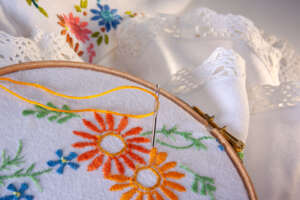
The 5 supplies you actually need to get started
Shopping for needlepoint supplies as a beginner can feel overwhelming, but the basics are straightforward. Here is what is genuinely necessary for a first project:
1. A canvas — This is what gets stitched. Beginners should look for a simple design with just two or three colors. Canvases come in two mesh sizes: 13 mesh and 18 mesh. The mesh count refers to the number of squares per inch, so 13-mesh has slightly larger squares. Both are beginner-friendly, and personal preference will develop naturally over time.
2. A needle — Most canvases come with one included, but tapestry needles with blunt tips are widely available at craft stores and online if a separate purchase is needed.
3. Thread — Needlepoint thread comes in several materials. For beginners, DMC soft matte cotton or DMC pearl are solid starting points. They are easy to find at most craft stores and tend to be the most budget-friendly option.
4. A needle threader — This small tool makes threading the needle quick and easy. Since threading happens frequently throughout a project, it’s well worth having on hand.
5. Small craft scissors — A compact pair for cutting thread is essential and gets used constantly.
For those who prefer a no-guesswork approach, beginner kits are widely available and include everything needed to complete a first project canvas, thread, needle, scissors and basic instructions typically ranging from $30 to $80.
How much does needlepoint cost?
Needlepoint is more of an investment than the average craft hobby, largely because most canvases are hand painted and threads are sometimes made by hand as well. Beginner kits generally fall between $30 and $80, while more advanced canvases can run from $50 to $150 before factoring in thread and finishing costs.
That said, there are real ways to keep spending in check. Shopping for DMC threads, purchasing digital canvas designs which typically cost between $5 and $10 or even painting your own canvas are all options worth exploring. It also helps to remember that needlepoint is a slow hobby by nature. A single project can take weeks to complete, which means the cost per hour of enjoyment is genuinely low. Starting with one project and finishing it before buying another is the most practical approach for anyone just beginning.
6 tips every beginner should know
Getting started is the hardest part, but these practical tips make the learning curve far more manageable.
Begin with the continental stitch. It is the most foundational stitch in needlepoint and will carry a beginner through most projects without needing to learn anything more complex right away.
Stitch in sections or work color by color either method works, and it ultimately comes down to personal preference.
Fix mistakes immediately. Undoing a stitch and redoing it right away is much easier than trying to go back and correct it several rows later.
Let go of perfectionism. A first project will have imperfections, and that is completely fine. The handmade quality is part of what makes it meaningful.
Lean into the community. Sharing work in progress photos on social media, looking for a local needlepoint store that hosts stitch nights, or simply connecting with others online can make the experience significantly more enjoyable.
6. Know that finishing is optional to do yourself. Completed canvases can be sent to professional finishers who will turn them into pillows, ornaments or other items. Many needlepoint stores offer this service, and it’s a great option for more intricate pieces.
Needlepoint is one of those hobbies that has a way of quietly becoming a meaningful part of a daily routine. Whether the appeal is the meditative quality, the creative outlet or the community it opens up, there has never been a better time to pick up a needle and get started.

