


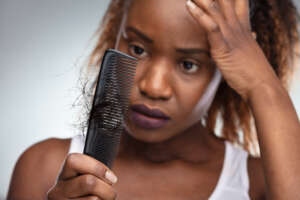
Alyssa Rios assumed she had avoided one of the more dreaded postpartum experiences. Months passed after the birth of her second child with no alarming changes to her hair. No clumps in the shower drain, no thinning at the hairline and no noticeable shedding when she ran her fingers through it. Then, nearly a year after delivery, she came across an old photograph of herself and realized something had quietly shifted. Her hair was no longer the full, thick head she remembered.
She could actually see through it in a way she never had before, and the realization left her feeling genuinely insecure about her appearance. What made it harder was that the change had crept up so gradually she had not even noticed it happening in real time.
Her experience is far more common than most people realize.
How pregnancy changes your hair and what happens after
Postpartum hair loss, medically referred to as postpartum telogen effluvium, affects more than 90% of people who give birth, according to dermatologists, though only about 30% to 50% experience shedding dramatic enough to notice visibly.
The process starts during pregnancy itself. Elevated estrogen levels during pregnancy cause a higher percentage of hair follicles to remain in the active growth phase for longer than they typically would, according to Dr. Oyetewa Asempa, assistant professor of dermatology at Baylor College of Medicine. That is why many pregnant women notice their hair looking fuller and shedding less than usual during those months.
The shift comes after delivery, when hormone levels drop sharply and suddenly. That hormonal change triggers a mass transition of hair follicles into the shedding phase, which is why the loss tends to show up not immediately after birth but around three to four months postpartum. The shedding phase can last anywhere from six to nine months, and in some cases up to a full year. During peak shedding, some people lose between 300 and 400 hairs per day, compared to the typical range of 50 to 100.
The emotional weight is just as real as the physical change
For Meg Ricci, a mother of a six-month-old, the shedding began right on schedule at three months postpartum. She had read about it in advance and initially felt prepared. But as the months continued and the shedding persisted, the emotional impact grew heavier. Like many postpartum parents, she also developed the short regrowth hairs along the hairline that are widely known as baby bangs, and she had not pursued any treatment out of concern about what might be safe while breastfeeding.
Bern Pichardo Jauregui, mother of a three year old, is still dealing with noticeable shedding years after giving birth. At a recent doctor’s appointment, she realized she had left a trail of hair behind her, a moment she found embarrassing. She has not pursued any remedies, partly out of habit and partly because she prefers a low-maintenance approach to her hair care.
Both women reflect a broader pattern among postpartum parents, where the condition creates a quiet but persistent effect on self-confidence that is rarely talked about as openly as other aspects of postpartum recovery.
Doing nothing may actually be the right call
One of the more counterintuitive pieces of advice from dermatologists is that for most people, the best approach to postpartum hair loss is simply waiting it out. The condition resolves on its own in the vast majority of cases without any intervention at all, according to Dr. Asempa.
She points out that the abundance of remedies circulating on social media can create a misleading picture. When someone tries a new scalp treatment and their shedding slows down three months later, it is easy to credit the product. But the timeline often coincides with the natural resolution of the condition regardless of what was applied. That does not mean all products are useless, but it does mean the bar for evaluating them should be higher than an anecdotal before-and-after.
Tracking recovery can also be genuinely difficult. For those experiencing diffuse thinning across the entire scalp, regrowth is harder to perceive than for those who lost hair in a concentrated area. Dr. Asempa notes that high definition photos are sometimes needed to show patients that their hair is in fact coming back, because the change is too gradual to detect otherwise.
Hair texture and volume can feel different even after recovery
For many postpartum parents, the relationship with their hair shifts even after the shedding stops. Pichardo noticed that her hair texture changed, feeling drier and different than it did before pregnancy. Rios, who has 4A natural hair, found that the most significant thinning had occurred through the midsection and ends of her strands. She ultimately decided to cut her hair into a bob to help it look fuller while it continued to recover, a choice her stylist was able to blend seamlessly.
Rios approached the change with a perspective shaped by a previous experience of cutting her hair short after relaxer damage in college. She knew that hair could grow back and that options existed in the meantime, including protective styles and wigs while the regrowth took hold. That sense of agency made the process feel less daunting even when it was emotionally difficult.
Postpartum hair loss can feel like one more way a person’s body has changed without their permission. But for most new mothers, it is a temporary phase, and with time, the hair does return.

